
Better tweet ideas start inside the work
Founders often look for tweet ideas outside the business: prompt lists, trend formats, or generic advice. Those can help, but the strongest ideas usually come from the work already happening.
Mine product decisions, customer questions, support friction, positioning tradeoffs, launch lessons, and things you changed your mind about.
Those sources produce posts that only you could write.
Turn each input into several angles
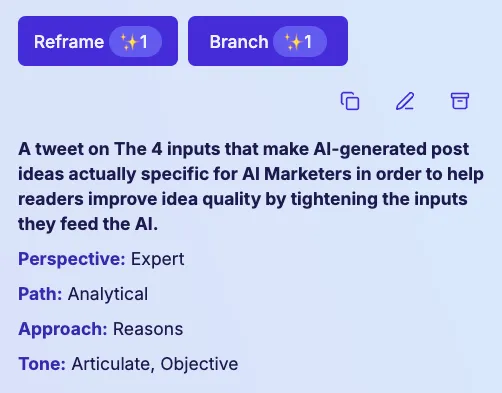
One product decision can become a lesson, a tradeoff, a mistake, a customer insight, a short checklist, or a question for other builders.
This is why idea quality improves when you branch before drafting. The first angle is not always the strongest.
Do not ask “what should I tweet?” Ask “what are five honest ways to frame this?”
Filter ideas before writing
A founder tweet idea should pass three checks: it has a point, it connects to a real example, and it would be useful to the audience you want.
If it fails one check, keep it in the backlog instead of forcing it into the queue. Weak ideas often become useful later when another example appears.
The queue should reward judgment, not just volume.
Founder tweet idea mining loop
Keep the process small enough to repeat when the week is busy.
- 1 Capture one real input Keep this step explicit before posts move forward.
- 2 Branch it into multiple angles Keep this step explicit before posts move forward.
- 3 Pick the audience-useful angle Keep this step explicit before posts move forward.
- 4 Draft several options Keep this step explicit before posts move forward.
- 5 Schedule only the strongest version Keep this step explicit before posts move forward.
Use tools to branch, not outsource judgment
AI can help generate draft options from a founder input, but it should not decide what you believe. Use it to widen the angle set, then pick and edit the post yourself.
TweetWizard is designed around that idea-to-draft step: turn a topic into options, then schedule only the version that earns its place.
Better tweet ideas come from better inputs and sharper selection.
Founder idea sources
Use this check before choosing the workflow or scheduling the post.
| Topic | Source | Example angle | Why it works |
|---|---|---|---|
| Product decision | Why we chose one constraint | Shows judgment | |
| Customer question | The answer we keep giving | Matches real demand | |
| Mistake | What changed our mind | Builds trust | |
| Launch lesson | What we would do differently | Useful to peers |
FAQ
Where do founders get better tweet ideas?
Start with product work, customer questions, decisions, mistakes, lessons, and opinions that come from the business.
How many ideas should one topic produce?
Try three to seven angles before drafting. That gives you options without turning the process into busywork.
Should founders use AI for tweet ideas?
Yes, if AI helps branch and draft from real inputs while the founder keeps final judgment.
More from this topic
Related TweetWizard guides
- Tweet Ideation & Angle Generation articles The topic cluster this article belongs to, with related TweetWizard guidance on the same publishing problem.
- AI tweet generator The profile-aware drafting workflow behind TweetWizard's article guidance on ideas, voice, and X post drafts.
- TweetWizard method How TweetWizard connects account context, idea generation, drafting, review, scheduling, and publishing.
Author
Waleed Salama
Founder, TweetWizard
Waleed Salama builds TweetWizard and writes about practical creator workflows for turning ideas into better X posts and sustainable publishing systems.